

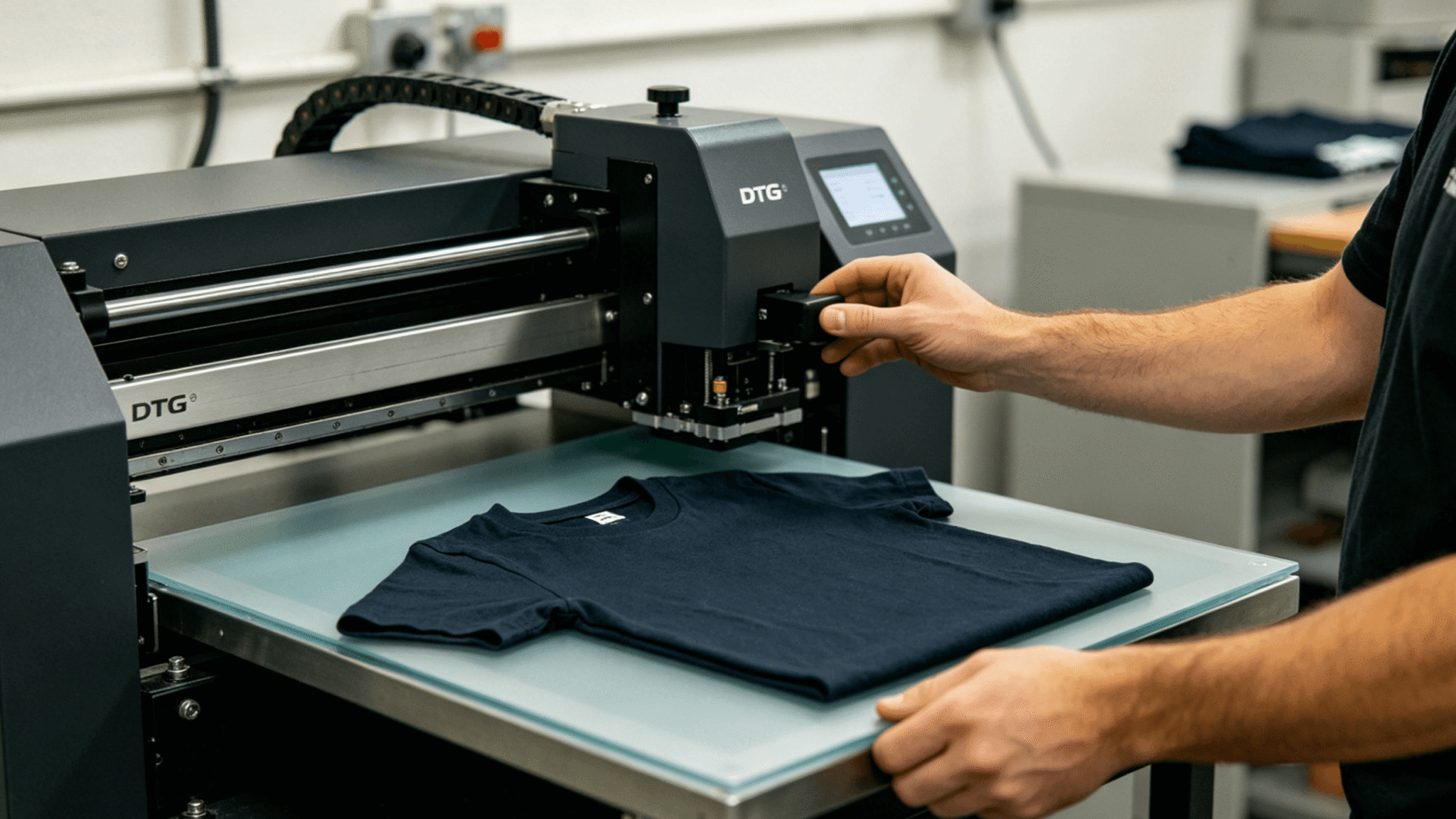
If you’re looking at the DTG market in 2026, the numbers look big. The industry is on track to hit nearly $4 billion by 2030, growing at 13% a year. But if you’re actually trying to run a business, the sticker price of a DTG printing machine price is rarely the whole story. The real headaches — and the hidden costs — usually come from ink, pre-treatment, and how much manual labor you’re stuck doing. In my experience, a cheaper machine often ends up being a money pit. Higher-end systems usually pay for themselves by cutting down on wasted ink and letting you print faster with fewer people.
Navigating the DTG printing machine price landscape means matching the cost to how much you actually plan to sell.
These are built for hobbyists or people running an Etsy shop from their spare room.
This is where most growing print shops land. It’s the sweet spot for reliability.
When comparing DTG printing machine prices, always calculate the ROI based on hourly output. An industrial machine at $50,000 that replaces four mid-range units will pay for itself through reduced labor and electricity costs within 12–18 months.
The purchase price is just the beginning. In most shops, the machine itself is only about 40% of the total cost. The other 60% is eaten up by consumables and labor.
Ink is the biggest variable. Light shirts are cheap—maybe $0.25 to $0.50 per print. But dark shirts require a white ink base, which jumps the cost to $1.50 or even $3.00 per shirt. White ink is thick, expensive, and prone to clogging.
You also have to deal with pre-treatment. If you do it by hand, it’s inconsistent. If you buy an automated pre-treater—another $1,000 to $3,000—you get better results but it’s another piece of gear to maintain.
Old-school DTG machines required you to be part-time mechanic and part-time chemist. By 2026, self-cleaning is standard on better machines. Automated systems that circulate the white ink can save you about 5–10% in wasted ink every year. I’d rather pay more upfront for a machine that cleans itself than spend an hour every morning with a swab and cleaning fluid.
Labor is one of the most underestimated components when calculating DTG profitability. Entry-level setups often rely heavily on manual workflows:
This limits scalability and increases per-unit labor cost.
In contrast, more advanced or hybrid systems—such as those offered by Cnding Group—integrate:
These features can significantly reduce operator workload, enabling a single operator to manage multiple machines or higher output volumes. As a result, labor cost per garment decreases as automation increases, directly improving margins.
Power consumption, while less significant than labor or consumables, also scales with machine size and usage. Industrial systems are generally more energy-efficient per unit of output due to higher throughput.
The true DTG printing machine price is not what you pay upfront—it’s what you pay per print over time. Businesses that focus only on initial cost often face higher long-term expenses due to:
In contrast, investing in more advanced, automated systems can significantly reduce hidden costs and improve overall profitability, especially as production volume grows.
When evaluating a DTG printing machine price, the most important question is not “How much does it cost ?” but rather “How fast can it pay for itself ?” In 2026, successful print businesses make decisions based on return on investment (ROI) and cost per print, not just upfront price.
A widely used ROI calculation in the custom apparel industry is:
Payback Period (months) = Total Investment ÷ (Net Profit per Shirt × Monthly Volume)
Where:
I always tell people to look at the break-even point.
| Metric | Entry-Level DTG | Cnding Hybrid System |
|---|---|---|
| Initial Investment | $5,000 – $8,000 | $30,000+ |
| Daily Output | 30–80 shirts | 200–500+ shirts |
| Labor Needs | High (Lots of manual work) | Low (Mostly automated) |
| Payback Period | 10–18 months | 4–8 months |
Entry-level DTG printers are attractive due to their low upfront cost. However, several factors slow down ROI:
Small-scale DTG operations often struggle to scale profitably due to these operational bottlenecks, even if initial investment is low.
Industrial solutions—especially hybrid systems like those from Cnding Group—are designed to optimize both speed and cost efficiency.
Key ROI advantages include:
By combining digital flexibility with screen printing efficiency, hybrid systems significantly improve cost-per-print, which is the core driver of ROI.
If you’re doing more than 200 shirts a day, an industrial system is actually cheaper. You save so much on labor and bulk ink that the expensive machine pays for itself twice as fast as the cheap one.
The true evaluation of a dtg printing machine price must include ROI, not just purchase cost.
For businesses planning to grow beyond small-batch customization, investing in efficiency, automation, and hybrid production technology is not an expense—it’s a strategy to accelerate profitability.
When analyzing the dtg printing machine price, the gap between a $5,000 entry-level printer and a $30,000+ industrial system is not arbitrary—it is driven by measurable differences in engineering, efficiency, and production consistency. In 2026, buyers are no longer paying for “just a printer,” but for a complete production system that reduces long-term operational costs.
One of the most overlooked factors in DTG cost analysis is machine stability over time. Entry-level printers are often adapted from desktop platforms, which can lead to:
In contrast, industrial systems such as those developed by Cnding Group utilize high-strength aluminum-magnesium alloy structures, a material widely used in high-precision manufacturing due to its excellent durability and stability.
According to materials engineering references, aluminum-magnesium alloys offer superior corrosion resistance and structural stability compared to standard aluminum, making them ideal for high-duty industrial equipment.
In practical terms, this translates to:
Over a 2–3 year production cycle, improved durability can significantly reduce total cost of ownership (TCO)—a key factor often hidden behind the initial dtg printing machine price.
Ink—especially white ink—is the single largest variable cost in DTG printing. This is where hybrid digital-screen printing systems create a measurable advantage.
Cnding’s hybrid approach combines:
This method is aligned with established industry practices. According to PRINTING United Alliance (SGIA), screen printing remains the most cost-efficient method for applying opaque white ink in high-volume textile production.
Why this matters:
Industry case studies and hybrid workflow analyses show that this approach can reduce white ink usage by 30% or more, depending on design coverage and production scale.
For businesses producing large volumes of dark garments, this directly lowers cost-per-print, making a higher DTG printing machine price economically justified.
Automation is one of the most critical factors separating entry-level DTG machines from industrial systems.
Cnding systems integrate:
Servo motors are widely used in industrial automation due to their:
According to industrial automation standards, servo-driven systems significantly outperform stepper motors in precision-critical applications like printing.
Operational impact:
In high-volume environments, even small gains in precision and speed compound into substantial profit improvements.
The difference in dtg printing machine price is ultimately a reflection of engineering value and production efficiency.
For growing businesses, these technical features are not “premium add-ons”—they are profit drivers that directly impact scalability and ROI.
Buying a printer in 2026 isn’t just about the DTG printing machine price. It’s about not getting stuck with a machine you’ll outgrow in six months.
If you’re just starting, go mid-range. If you’re actually moving volume, look at the industrial hybrid stuff from companies like Cnding Group. It’s a bigger check to write today, but you’ll be much happier when you’re actually making a profit on every shirt.
In 2026, the DTG printing machine price is an investment in your shop’s future scalability.
Ready to scale your production? Explore the latest Industrial DTG & Hybrid Solutions at Cnding Group to find the perfect balance of price, performance, and precision.
Prices fall into three tiers: Entry-level ($3,000–$7,000), Mid-range Professional ($13,000–$25,000), and Industrial High-Volume systems like the Cnding H9PRO ($45,000–$100,000+).
Light garments typically cost $0.25–$0.50 per print. Dark garments (requiring white ink) cost $1.50–$3.00. Hybrid systems can reduce these costs by 30% by using screen-printed white underbases.
Higher upfront costs buy durability and automation. These features minimize downtime and labor costs, leading to a much lower Total Cost of Ownership.
DTF has lower initial costs ($1.00–$2.00 per print) but a textured feel. DTG is the gold standard for premium, soft-hand retail quality. For volumes over 200/day, Cnding Hybrid systems offer the best ROI by combining both technologies.
While the DTG printing machine price is higher for industrial units, they often reach 100% ROI within 4–8 months due to high-speed output and reduced waste.
Introduction Custom apparel is hitting massive numbers, with the market expected to pass $45 billion by 2030. If you’re looking at the scene in 2026, Heat Press Vinyl (HTV) is...
Introduction The apparel industry has exploded lately. We’re looking at a market projected to hit $17.5 billion by 2027, mostly because everyone wants custom gear, unique merch, and fast-fashion pieces...
Introduction The custom t-shirt business is on a serious roll. Experts think the global market will hit around USD 5.1 billion by 2026. Even with all the new tech out...