


How Many T-Shirts Can Be Screen Printed with 1 Kg of Ink
It’s not just about the number of shirts. It’s about what kind of shirts and what kind of design. Let’s break it down.
Every screen printer, from the garage hobbyist to the seasoned professional, has stared at a fresh, gleaming kilogram of plastisol ink and wondered, “How many shirts is this actually going to get me?”
The internet will give you a quick, unsatisfying answer: anywhere from 300 to 800.
While technically true, that range is so vast it’s almost useless. It’s like saying a tank of gas will get you somewhere between the grocery store and a cross-country road trip. The truth is, your ink mileage has very little to do with a standard average and everything to do with the specific job in front of you.
So, let’s ditch the vague estimates and talk about what’s really eating up your ink.
It All Starts with the Art (and the Color)
Before your ink even touches a screen, the design file dictates most of its fate. This goes deeper than just size.
- The Footprint: This one’s obvious. A minimalist left-chest logo might only use a gram or two of ink. A full-back, concert-style graphic with solid coverage could easily use four or five times that amount. Your print’s physical size is the number one driver of consumption.
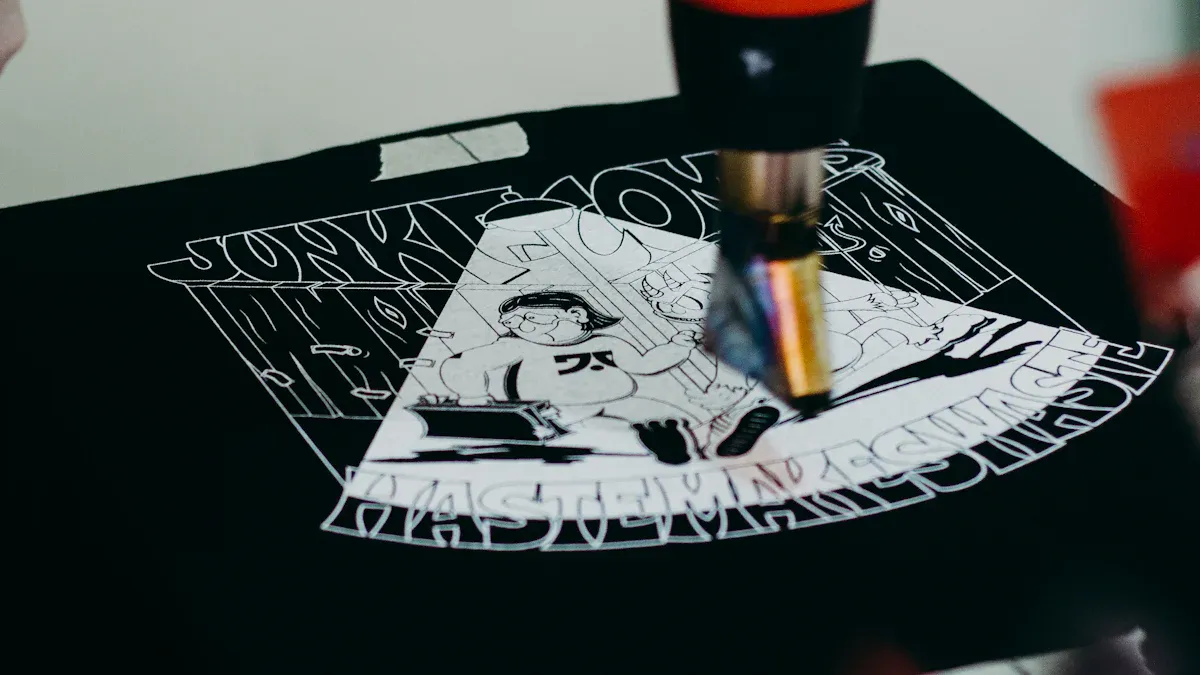
- The Color Conundrum: Printing light-colored ink on a dark garment is where ink vanishes. To get a vibrant white print on a black tee, you need an opaque layer. This often means laying down a white underbase, flash-curing it, and then printing another layer of white on top. You’ve just printed the same design twice, effectively halving your ink mileage for that job.
The Fabric Factor: Not All Shirts Are Created Equal
This is the variable most beginners overlook. The fabric you’re printing on dramatically changes how ink behaves and how much you need to use.
The Standard: 100% Ringspun Cotton
This is your baseline. A good quality cotton shirt has a relatively smooth and absorbent surface. The ink sits nicely, and with proper technique, you can achieve a clean print with a standard amount of ink. This is where those “average” estimates come from.
The Sponge: Hoodies and Fleece
Ever printed on fleece? It’s thirsty. The soft, textured, and highly absorbent nature of fleece fabric means it soaks up ink like a sponge. To get a smooth, bright print, you almost always have to use a “print-flash-print” method—laying down one layer, curing it for a few seconds, and applying another right on top.
A design that takes one pass on a cotton tee might take two or three on a hoodie to look right. This can cut your ink yield by 50% or more for the exact same design.
The Slick Impostor: 100% Polyester and Synthetics
Performance wear and athletic apparel present a different challenge. Polyester isn’t absorbent; the ink sits on top of the fibers. The real enemy here is dye migration, where the dye from the fabric bleeds into your ink over time, turning your crisp white print into a murky pink or grey.
To combat this, you need special low-bleed or polyester-specific inks. These are often formulated to be printed in thicker layers or require a special dye-blocking underbase. Either way, your process changes, and you’re often using more ink per piece than on standard cotton.
A Tale of Two Prints
Let’s imagine you have 1kg (1000g) of white ink.
Job #1: The Corporate Order. Garment: 100% cotton t-shirts.
- Design: A small, 2-gram text logo on the left chest.
- The Math: 1000g÷2 g/shirt=500 shirts. A solid, profitable run.
Job #2: The Local Sports Team.
- Garment: Heavyweight fleece hoodies.
- Design: A large, solid back mascot that needs a print-flash-print technique. The first layer uses 3 grams, and the second uses another 3 grams, for a total of 6 grams.
- The Math: 1000g÷6 g/shirt≈166 shirts.
It’s the same kilogram of ink, but the fabric and design resulted in less than one-third of the output.
Know Your Job, Know Your Yield
Stop thinking in terms of “shirts per kilogram.” Instead, start thinking about “grams per print.”
Printing on 50 black hoodies is not the same as printing on 50 white cotton tees. Your ink cost—and your time—will be vastly different. Understanding where your ink is going isn’t just good business practice; it’s the mark of a true craftsman.